A hands-on comparison of Adobe Express vs Google Workspace for filmmakers, exploring design, collaboration, and real-world workflow stress tests.
hello world!


In the beginning, people created web empires with content written by bots. As a result, AI-generated content falls into one of the original definitions of spam. Rebranding "bot-generated content" as "Artificial Intelligence" does not change that.
I've read reviews from paid affiliate bloggers with "no bias" that Rytr and other NLP tools can do the job of a copywriter.
Now, the statement above is pretty grand. It would be exhilarating if true. I managed teams of copywriters in my current and previous roles. If a robot can do the job of all of them, that would be revolutionary.
At first glance, the copy Rytr produced was compelling. I even imagined popping up a whole website overnight and taking over the internet. On closer inspection, the copy Rytr produced needed lots of work.
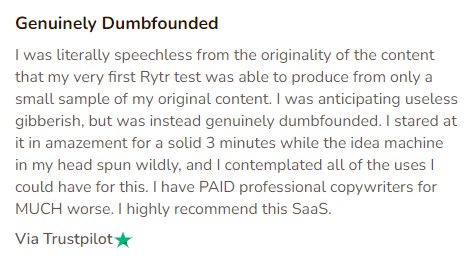
The futurists like to taunt AI as if the future is already here. Some claim they've paid content creators to write worse content than what Rytr produces, which is interesting because the copy Rytr made was so bad that I wonder who the person below hired.
To test whether or not Rytr can write SEO-optimized long-form content, I asked Rytr to create outlines and blog sections. Those tests resulted in Rytr producing a comical mixture of unusable and made-up.
By the end of this review, I hope you will gain deep insight into how Rytr works, how it can be applied, and what it doesn't do.
Rytr Review - Incoherent Franken-Blogs

Summary
The best implementation of Rytr is for short-form content. It is decent at rewording paragraphs, ad copy, product descriptions, or developing content for parts of your website.
The outlines Rytr produced for "SEO" were thoroughly academic, with a beginning, middle, and end. The issue with that is that the length and structure of the content should be related to the query's intent. Thus, the high school essay-style outline is useless for just about every use case.
Instructing Rytr to write a long-form blog was an entertaining exercise. People don't need help creating low-quality content, and that's precisely what I ended up creating with this tool. On the plus side, Rytr definitely creates original content!
Rytr is an AI-powered copywriting tool that helps marketers and content creators. It uses neural networks to generate human-sounding copy.
It also comes with a free trial period, and the paid plans are very affordable.
Based on my experience with Rytr, you will need an unlimited plan to get it to produce something usable.
You can look at the different pricing tiers on Rytr's pricing page here.
The best thing about Rytr is the feature rephrase. Another plus is that one can also select the tone the bot writes in.
| Feature | Free plan | Saver plan | Unlimited plan |
|---|---|---|---|
| Pricing | $0 | $9 | $29 |
| Monthly character limit | 10,000 | 100,000 | Unlimited |
| 40 use cases | ✔️ | ✔️ | 610,00 |
| Writes in 30 Languages | ✔️ | ✔️ | ✔️ |
| 20+ tones | ✔️ | ✔️ | ✔️ |
| Built-in plagiarism checker | ✔️ | ✔️ | ✔️ |
| Access to premium community | ✔️ | ✔️ | ✔️ |
| Create your own custom use-case | ✔️ | ✔️ | ✔️ |
| Dedicated account manager | ❌ | ✔️ | ✔️ |
| Priority email & chat support | ❌ | ❌ | ✔️ |
According to Rytr's about section and other sources, Rytr is built on top of GPT-3.
Rytr and other Natural Langauge Processing (NLP) models work by taking the context of the previous words or sentences and guessing the statistically likely next word, like a fill-in-the-blank word game.
Many AI-generation models require some arbitrary amount of text to function. The next word it can guess is statistically significant at one word, but at 30 words, the next word it can think diminishes dramatically.
If a human had written three paragraphs and was only missing a noun in the last sentence, the number of words one could guess would also diminish dramatically.
Given that Rytr's output depends on the source data and the words currently on a given page. It implies that Rytr cannot form an opinion on anything because it simply guesses the next word. Rytr might produce misleading or completely arbitrary content because of the source data it is fed.
Let's test it out.
The prompt I provided Rytr was to write a review about itself.
Given that Rytr relies on source material to generate its content, another subject might have produced better results.
Rytr is designed with several features to make it easy to produce text.
You can start by uploading some short descriptions of the content you want it to generate and choose from various outputs that suit your needs.
You can select between 20 tones, 30 languages, and 40 use cases.
The text Rytr produces is practical, like product descriptions, SEO meta titles, SEO meta descriptions, and SEO-optimized blog outlines, in a tone of your choice, like convincing, formal, or informal.
You can enter words into the text box with simple guidelines and see what it generates. Or you can enter your sentence and ask Rytr to rewrite, improve, continue writing, or rephrase.
I prompted Rytr to generate outlines. To do so, I clicked on the dropdown, chose "Blog Idea & Outline," and gave it the keyword "Rytr AI Review," generating three outlines.

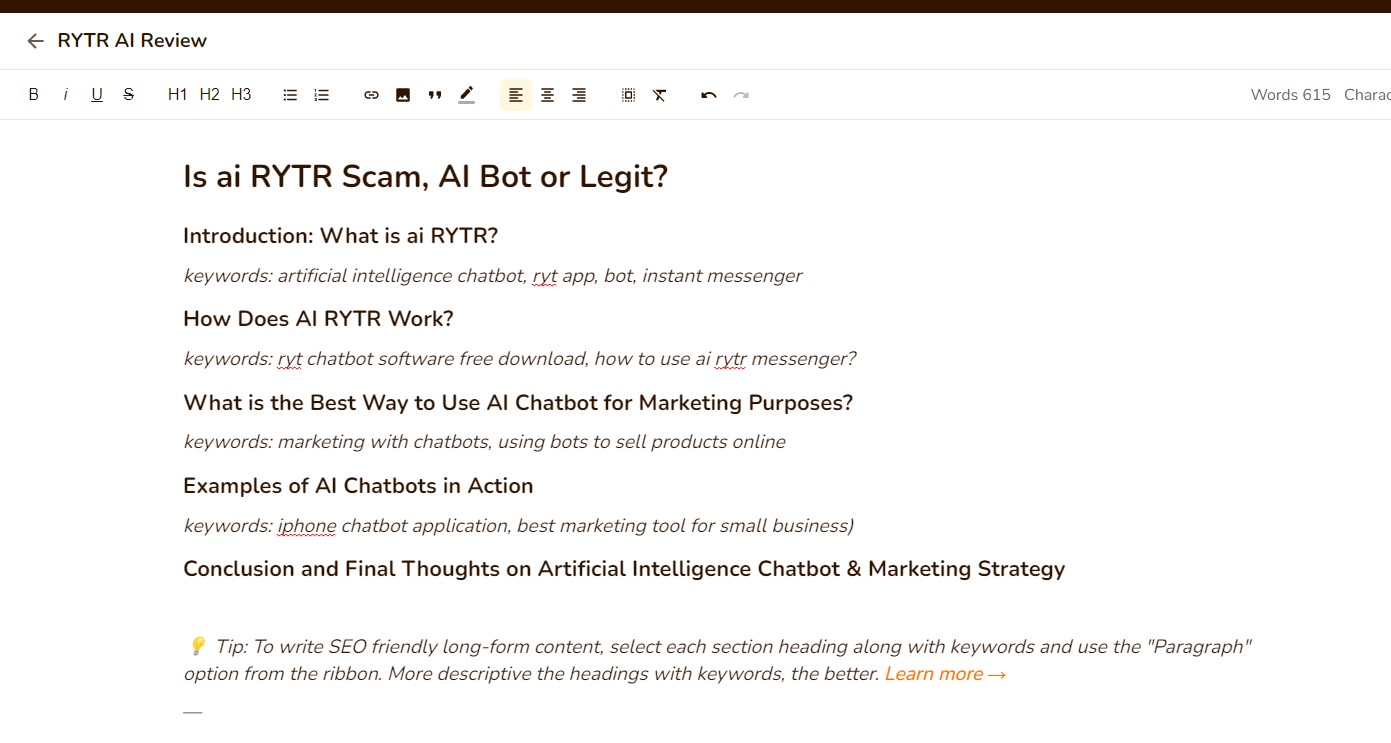
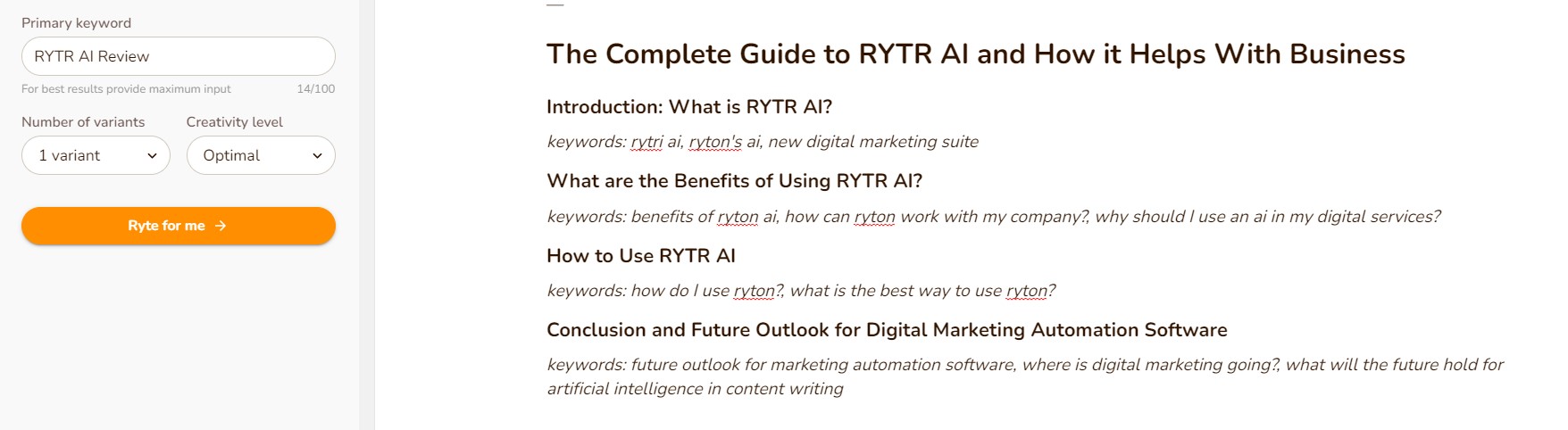
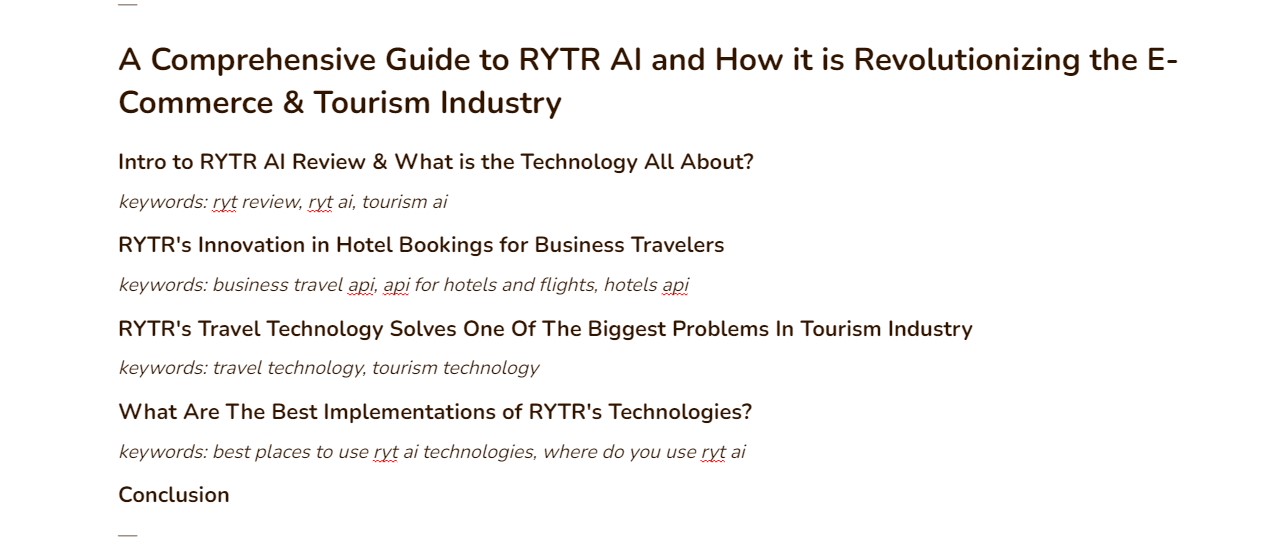
The outlines were all a little bit off. Some were a bit specific, but that's not necessarily bad.
Some of the content was so obviously wrong that it was comical. How did it even write the following?
What is the Best Way to Use AI Chatbot for Marketing Purposes?
keywords: marketing with chatbots, using bots to sell products online
Rytr output
The semantics are close, but the headlines are the most critical part of a piece of content; a slight variation in the title and the content might not rank for the target query.
Most of the outlines needed so much work that using them would have taken longer to fix than just starting from scratch.
Using one of the blog outlines. I followed the instructions Rytr provided and asked it to generate another blog section.
To do that is simple enough, you highlight the keywords and headlines Rytr generated and press a button, then Rytr will produce an SEO-optimized article section.
The following is the result.
Impressive! Typically SEOs go to great lengths to add words to meet some word count, and this bot does it effortlessly.
I Googled RYT, and Rytr is in the top ten results. There is content about fitness and health, so maybe the bot is combing all of these things. It's also possible that the content Rytr produces is more random than I thought because Rytr does not mention fitness or yoga in other experiments.
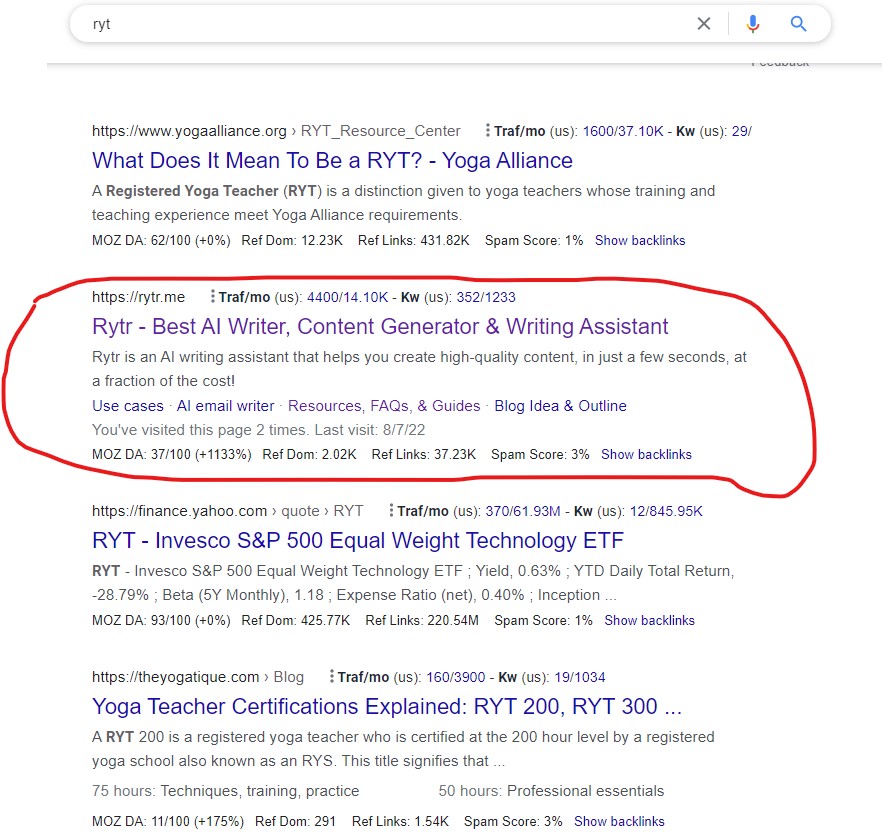
Rytr truly shines for its ability to generate words randomly. In some contexts, say you wanted to prop up a site with 10,000 pages, Rytr could randomly generate words to help you fill those pages with content. Rytr connects via API so the work can be done remotely and quickly. Rytr could generate barely legible content and save you hours of work. For most of us, randomly generated words on a page won't cut it.
To generate another section, I added the headline into the "section topic" container and the keywords into the "section keywords" container.
I learned that the keywords influenced the output. For example, even though I asked the machine to generate an outline about Rytr AI, Rytr took the liberty of determining that I meant for it to write a blog about RYT, a made-up messaging app, and it included keywords about RYT in the keyword section.
So I asked Rytr to write a blog section again; this time, I modified the keywords Rytr generated from "ryton" to "rytr.ai" to be more specific.
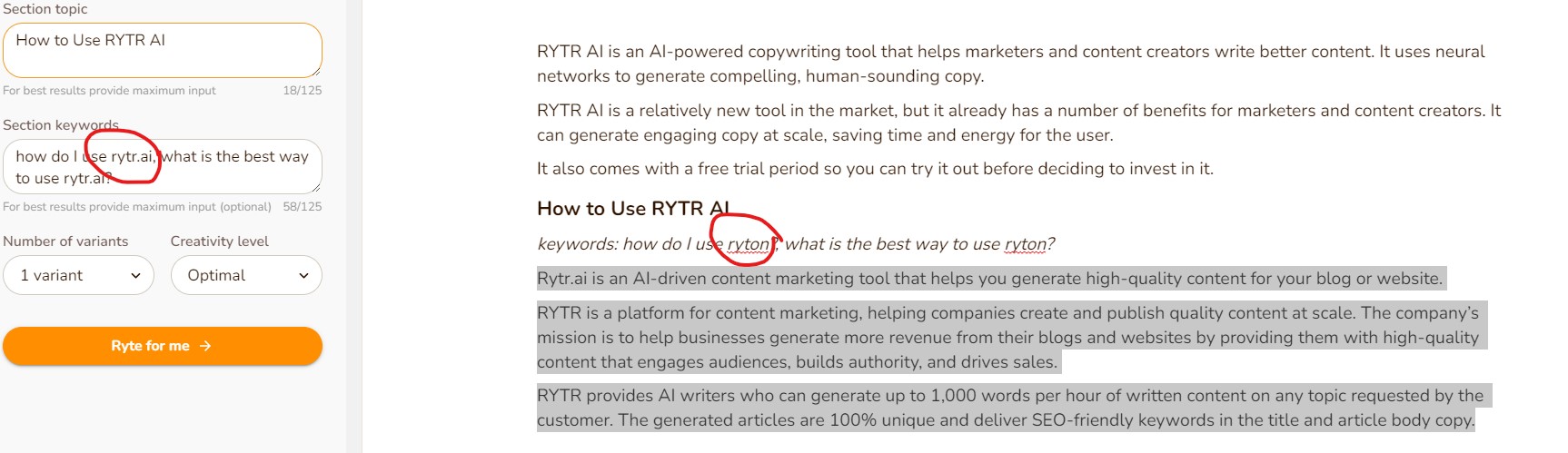
And it did it! Rytr made something usable! Read the following carefully.
RYTR provides AI writers who can generate up to 1,000 words per hour of written content on any topic requested by the customer. The generated articles are 100% unique and deliver SEO-friendly keywords in the title and article body copy.
Rytr
So at first glance, Rytr made some content about Rytr. However, it managed to completely fabricate some facts about itself.
The text Rytr produced reminded me of the bot-generated content from the 1990s.
Asking Rytr to continue filling in the other sections. The content was remarkable for a whole host of reasons.
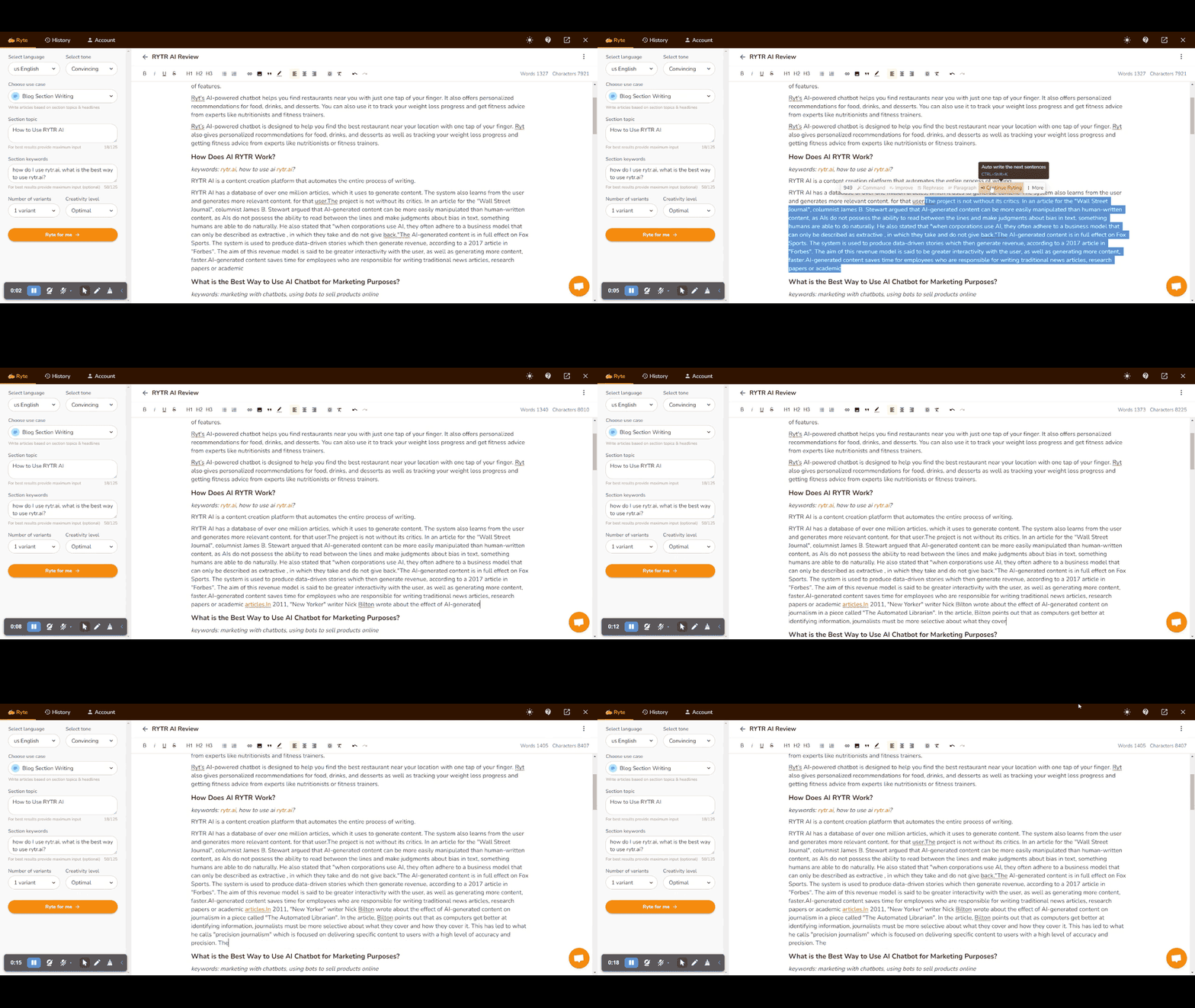
In 2011, "New Yorker" writer Nick Bilton wrote about the effect of AI-generated content on journalism in a piece called "The Automated Librarian." In the article, Bilton points out that as computers get better at identifying information, journalists must be more selective about what they cover and how they cover it. This has led to what he calls "precision journalism," which is focused on delivering specific content to users with a high level of accuracy and precision.
Rytr output
I Googled Nick Bilton to find the article Rytr was referencing, and Google returned "0 results". I am amazed; I don't know the last time Google wasn't able to find something. Nick Bilton is a real journalist as well.
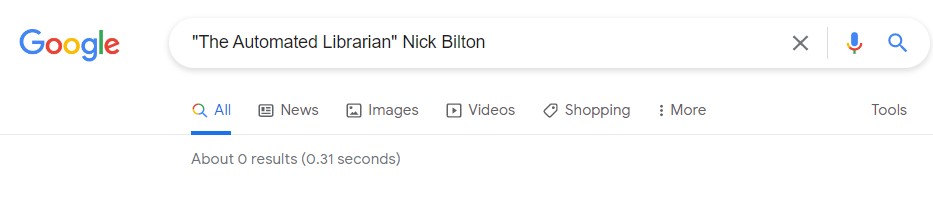
That may not seem like a big issue. But it is. This bot randomly makes up things about people and could potentially place you in legal trouble. Nick might consider it defamatory if you misrepresent his work.
I've tested a few of these tools, and I have also found similar results from the other tools. Why? Because they're all built on top of the same models. They all tend to ramble about nonsense and make things up.
I ran all 2000 words of Rytr's text through Grammarly to check for plagiarism; only 6% came up as copied. Much of that was generic, like “In an article for the Wall Street Journal.” If that is the kind of stuff that comes up as copyright infringement, that’s pretty good.

So rather than try to fix or explain the rest of the content that I asked Rytr to write, which is an exhausting exercise, I’m going to introduce the concept of value. Even if a bot could generate decent content, would it add value? Does the bot have experience? Expertise? Can it use and therefore review a product the same way I'm reviewing it now? Or does the bot only pretend that it can do those things? Continuing my review, I will add more of that value that only a human with an opinion can add.
The best implementation of Rytr is for short-form content. It is decent at rewording paragraphs, ad copy, product descriptions, or developing content for parts of your website.
Rephrase is my favorite feature because SEOs often need things rephrased.
Practical use case: When writing web content for a new website, the content is often short and descriptive. But it's also essential to get it right. Rephrase helped me go through different iterations of the synonyms quickly.
Practical use case: A popular local SEO technique is to create hundreds of pages about the same subject but change the location names throughout the text. For example, a page about "Denver Colorado Plumbing" and "Pueblo Colorado Plumbing" could use the same content, but SEOs go out of their way to make it unique. This process helps local SEOs avoid Google's spammy doorway page definition. At one point in my career, I had a team of writers who would write the same content, just worded differently. Rytr could have helped out a lot with just its Rephrase feature. Not that Rytr could replace the writers completely, partially because the Rephrase feature is limited to only a few sentences at a time. But Rytr still would have saved us a ton of time.
Rytr comes with a free trial period, so you can try it out before deciding to invest in it.
Should you use Rytr for SEO? Flat out No.
As a professional SEO, I see some obvious issues with using AI-generated content. And the recommendations from professionals on using this type of content make me question their judgment.
You might get lucky and accidentally rank for some terms with AI-generated content. However, even to an uninformed observer, Rytr produces spammy long-from content. It adds no value to a conversation and can only regurgitate random concepts it finds on the internet, resulting in incoherent "franken-blogs."
The content you produce with Rytr might come up as spam. I recommend Rytr for maybe brainstorming headlines, but that's about it.
This technology is still new. It functions well with short phrases but has a long way to go if the goal is to generate long-form content.
What is the meaning of the content creator's existence? What is the raison d'etre? Why does a given piece of content need to exist if it does not add value?
In one of the blogs, Rytr produced the following quote.
Rytr is an AI writing assistant that can generate content at scale. It is best for companies who don't have the time or skillset to generate content for their clients.
I agree; Rytr is a tool for people who don't have the skill set to create exciting content.
The content Rytr ended up producing was questionable. I could only use a few portions of it at best.
This technology has applications in customer service, education, and healthcare. It could probably function as a chatbot.
The paid plans are also very affordable. For $29.00, you get an unlimited character count.
Yes and no. The two are built on top of GPT-3, so they share many of the same issues.
Rytr offers 10k free characters per month.
They're all bad.
Google defines AI-generated content as spam. By using AI-generated content, your website could be taken off the index.
At no extra cost to you, reviewers and secret shoppers may earn an affiliate commission from links on this site. Read more about our editorial policies. Interested in working with us? Email solutions@comprable.com
A hands-on comparison of Adobe Express vs Google Workspace for filmmakers, exploring design, collaboration, and real-world workflow stress tests.
A hands-on 2026 comparison of Adobe Express vs Canva for filmmakers. We stress-test both platforms across pitch decks, teaser trailers, lower thirds, thumbnails, and festival one-sheets to see which tool actually holds up in a professional workflow.
Top AI consulting firms compared by delivery model, focus area, and build capability. A practical guide for enterprise leaders.
I’ve read 85 books this year, and this list is my top 10 books of the year. P.S. All these are 5/5 stars
From e-commerce and gaming to automotive and care products, discover why Wix stands out as a versatile, fast, and cost-effective platform.
Based on millions of websites, GoDaddy is the fastest website builder with the highest Lighthouse scores of 70/100, Wix secured second with 62/100.
A hands-on comparison of Adobe Express vs Google Workspace for filmmakers, exploring design, collaboration, and real-world workflow stress tests.
A hands-on 2026 comparison of Adobe Express vs Canva for filmmakers. We stress-test both platforms across pitch decks, teaser trailers, lower thirds, thumbnails, and festival one-sheets to see which tool actually holds up in a professional workflow.
Top AI consulting firms compared by delivery model, focus area, and build capability. A practical guide for enterprise leaders.

Comprable is a source of product reviews, comparing prices and features for you.
Product reviews are generated by fellow shoppers like you.