A hands-on comparison of Adobe Express vs Google Workspace for filmmakers, exploring design, collaboration, and real-world workflow stress tests.
hello world!


Prismic is a dynamic entrant to the industry, often called the "WordPress for coders." While this analogy has been used in marketing previously, it is worth noting that the true WordPress for coders is the Oxygen Page Builder.
As an experienced professional in the field, I have worked on and developed numerous WordPress sites, including the one you are currently on. However, my team and I were recently presented with a significant challenge: constructing a complex website utilizing React.js and Prismic.
It was an experience that I would not wish on my enemies.
Prismic Scorecard
Summary
Prismic does nothing out of the box; you need an entire dev team to get it to turn on. The things you'd expect a normal CMS to do, like taxonomies, blog functions, or simple search functions, are not fully developed within Prismic. Meaning your dev team will have to do basically everything from scratch.
Why use Prismic when WordPress also supports a headless CMS?
Ask yourself, is your company a web development company? If you don't sell websites as a product or work for an agency that professionally delivers websites, then you should avoid Prismic. And if you do sell websites as a product, you should still avoid Prismic.
The only reason I agreed to move forward with Prismic was that my developer team told me that it was impossible for a WordPress site to be faster than a Prismic.io site. The theory went that Prismic was a headless CMS. Therefore, it had to be faster.
Creating a headless CMS version of WordPress proved to be a quick process for WordPress developers, one of the benefits of open-source coding.
As a result, any concerns raised by my team regarding the viability of a WordPress-based headless solution were resolved just after my team had already committed to creating a Prismic site.
I wish I had done the following exercise before agreeing to build a site in Prismic. I am sharing my experience with you as a warning.
Cedric C.
I was unable to find speed benchmarks for Prismic. Which begs the question, where did the idea that Prismic was fast come from? So to benchmark it, we will compare the websites featured on Prismic.io to those featured on WordPress.org.
During the speed testing process, I noted that the Prismic sites were built using various libraries, unlike WordPress sites which remained fairly consistent. While there may be a fast Prismic site out there, the fastest one I found only scored 61/100 on Lighthouse, which isn't even passing.
WordPress is an open-source PHP-based management system. It has been around for a long time, and approximately 1 out of 3 sites are made with WordPress. WordPress has the advantage of being open-source, meaning there is a large developer community around it, with thousands and thousands of plugins made for it. WordPress is so popular that just about every piece of software, every 1st or 3rd party tool, and every 2nd or 3rd party system has a built-in integration. And if it doesn’t, then hiring coders to do the work is actually relatively cheap. WordPress, out of the box, can handle 99% of use cases.
With an optimized theme from Oxygen and some free plugins, Autooptimize and EEEW Image Optimizer. Any WordPress site can achieve 90/100 Lighthouse scores for the lifetime Oxygen page builder subscription cost.
Like Prismic, Oxygen has a slice system built in.
WordPress is also a headless CMS.
Prismic is a Headless CMS that offers a range of features for content management, including content modeling, content localization, versioning, and scheduling. While it may not have all the features of a traditional CMS, it is designed to be flexible and customizable, allowing developers to build unique solutions for their clients.
As of April 2023, here is how Prismic.io describes Headless CMSs on their website:
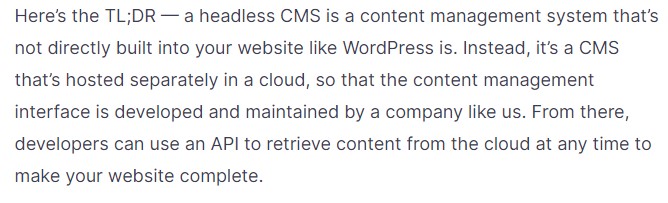
Now, the idea suggested sounds fancy. However, there is already an issue. Why the heck do I want to call every element on my site via API? So I can pay someone to use their API?
Now I love the idea of paying a corporation for every tiny element that my visitors access.
It's important to evaluate any content management system, including headless CMS options like Prismic.io, based on their actual performance and how they fit with the specific needs of a particular website or application. WordPress is also a headless CMS, so Prismic.io's statement about WordPress is wrong.
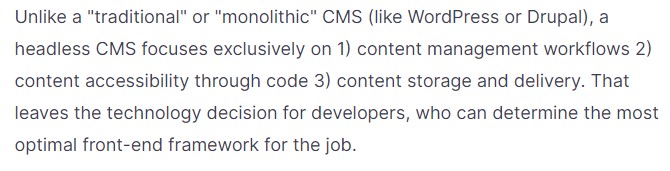
When discussing content management systems, with or without headless architecture, it is essential to consider the critical factor of website speed. Achieving optimal website speed can be a multifaceted and time-intensive process, requiring specialized skills and dedicated resources.
In my extensive professional experience, I have found that developing speed-optimized websites can present significant challenges for teams with limited resources, typically those with 3000 or fewer engineers. As a general rule of thumb, building a custom-built fast website from scratch may not be feasible if your company is not Amazon.
If you choose to build a website in WordPress, it is possible to build a fast, custom website with only a few developers.
Lighthouse is Google’s UX testing tool; it helps websites establish quantitative measures for a good user experience. One core component of Lighthouse is the speed a page takes to load.
There are many industry benchmarks for the speed of websites; however, we have yet to discover industry benchmarks for Prismic.
We should compare sites with the exact same builds, but that's not as easy as it sounds. One way to think about this test is if you were to pick a random WordPress site on the web and a random Prismic site on the web, what would you expect the speed the be?
Prismic is a Private CMS that you build using your code of choice. WordPress is an open-source CMS that you build using your code of choice.
Headless CMS, CDNs, and static caching are not exclusive to Prismic; WordPress offers the same solutions.
Which poses a question: where did the notion that Prismic is fast come from?
To establish an industry benchmark for Prismic, I sampled 20 sites featured on the Prismic.io showcase. I tested the websites using the following criteria.
The averaged results from the tests are shown below.
| Notably, the biggest brands that use Prismic are Fanduel and Spotify. Fanduel uses Prismic + WordPress, while Spotify only uses Prismic for one landing page. I did not see Google or the other brands featured on the Prismic homepage in the featured site's section. |
| Prismic | ||||
| onLoad Seconds | TTFB | LCP Seconds | Size (MB) | Lighthouse score |
| 6.77 | 759ms | 4.52 | 3.95 | 35/100 |
Using the same testing standards, I tested 20 WordPress sites that were featured on wordpress.org/showcase/.
| Many notable brands use WordPress, such as Bloomberg, Vogue, The White House, Tech Crunch, Sony Music, Toyota, and Adobe. |
| WordPress | ||||
| onLoad Seconds | TTFB | LCP Seconds | Size (MB) | Lighthouse score |
| 6.43 | 701.42ms | 3.42 | 4.6 | 44/100 |
The WordPress websites had an average onLoad time of 6.43s and 44/100 lighthouse scores.
Prismic had a -8.32% slower TTFB, +32.0% higher LCP, and -20.34% lower lighthouse scores while serving -13.5% less content.
Prismic lost on every metric while serving 13.5% less content.
Note that one cannot build a Prismic site without access to full-stack developers, so a comparison to low-code or no-code setups like WordPress is not fair; Prismic sites require much more resources.
WordPress benefits from a large community of skilled developers who are passionate about website performance and have created many plugins designed to optimize speed with ease. The platform also offers well-established content management workflows that have been refined over time. These strengths make WordPress a valuable option for many types of websites without necessarily requiring a complete overhaul of the content management system.
WordPress is also a headless CMS.
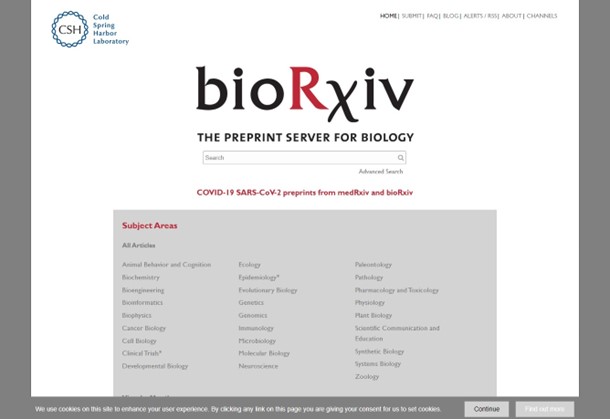
bioRxiv.org (WordPress PHP)
| onLoad | TTFB | LCP | Size MB | Lighthouse score |
| 3.2s | 959ms | 2.2s | 0.394 | 73 |
Interestingly, even though bioXriv.org was not optimized, it still achieved better Lighthouse Scores and LCP than many Prismic sites.

BHphotovideo.com (Drupal PHP)
| onLoad | TTFB | LCP | Size MB | Lighthouse score |
| 1.6s | 779ms | 1.2s | 1.35 | 81 |
It's important to note that websites like BHphotovideo.com, which is built with Drupal and has a high number of elements on its page, outperformed most other websites, both headless and traditional.
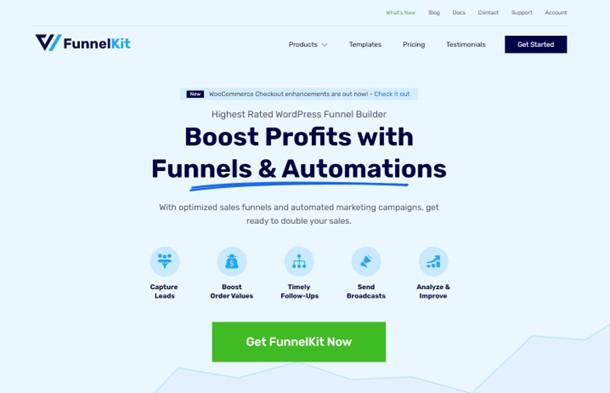
Funnelkit.com (WordPress PHP)
| onLoad | TTFB | LCP | Size MB | Lighthouse score |
| 2.0s | 689ms | 1.5s | 1.46 | 94 |
Funnelkit.com, a WordPress site, achieved impressive results with a low TTFB of 689s, LCP of 1.5s, and a Lighthouse score of 94/100, outperforming Prismic sites.
Comparable.com has 94/100 Lighthouse Scores; it runs on a managed WordPress hosting provider that costs $20 per month. It has all the perks, Redis object cache, auto image formatting, image compression, and Managed 24/7 support. Auto updates and a global CDN. I know this is shocking to hear, but my WordPress site was built with a normal CMS, so it has a head. On top of an optimized theme from Oxygen, my website also uses the free versions of the following software; Autooptimize and EEEW Image Optimizer.
However, if you are really obsessed with the latest trends. WordPress can be used as a headless CMS, which provides greater flexibility for developers to create custom front-end applications or websites using their preferred technologies while still benefiting from WordPress's powerful content management features. Additionally, WordPress is a highly customizable platform that can be adapted to suit a wide range of website needs and requirements.
At no extra cost to you, reviewers and secret shoppers may earn an affiliate commission from links on this site. Read more about our editorial policies. Interested in working with us? Email solutions@comprable.com
A hands-on comparison of Adobe Express vs Google Workspace for filmmakers, exploring design, collaboration, and real-world workflow stress tests.
A hands-on 2026 comparison of Adobe Express vs Canva for filmmakers. We stress-test both platforms across pitch decks, teaser trailers, lower thirds, thumbnails, and festival one-sheets to see which tool actually holds up in a professional workflow.
Top AI consulting firms compared by delivery model, focus area, and build capability. A practical guide for enterprise leaders.
I’ve read 85 books this year, and this list is my top 10 books of the year. P.S. All these are 5/5 stars
From e-commerce and gaming to automotive and care products, discover why Wix stands out as a versatile, fast, and cost-effective platform.
Based on millions of websites, GoDaddy is the fastest website builder with the highest Lighthouse scores of 70/100, Wix secured second with 62/100.
A hands-on comparison of Adobe Express vs Google Workspace for filmmakers, exploring design, collaboration, and real-world workflow stress tests.
A hands-on 2026 comparison of Adobe Express vs Canva for filmmakers. We stress-test both platforms across pitch decks, teaser trailers, lower thirds, thumbnails, and festival one-sheets to see which tool actually holds up in a professional workflow.
Top AI consulting firms compared by delivery model, focus area, and build capability. A practical guide for enterprise leaders.

Comprable is a source of product reviews, comparing prices and features for you.
Product reviews are generated by fellow shoppers like you.